“All Day All Night” Exhibition Review
- genevievejieunwon
- Jun 25
- 6 min read
“She is such a good story-teller”. Two men stood in front of me said to each other. Right after recognizing them saying about her work, the idea of “communicating” popped into my mind. What is a good story-teller? How do we deliver stories?
At Whitney Museum of American Art on view from Feb 8 to July 6, 2025, floors -1, 1, 3, and 8, “Christine Sun Kim: All Day All Night” is her exhibition of sound, installation artwork, drawings, murals, paintings, video installations, and sculptures that she has been created from 2011 to 2024. Born in Orange County, now based in Berlin, Christine Sun Kim was born in hearing parents and have a deaf older sister.
She began working at Whitney as an educator in 2008. She continued involving in museum, collaborate to enhance accessibility and engagement for Deaf museumgoers. Until now, Whitney has monthly tour for deaf visitors. And this year, she is having her own exhibition at a museum where she worked for more than 6 years.
I was first interested in the exhibition just because of her name. By her last name, I could tell she is Korean-American. At first, I had no idea that she is deaf just by seeing her name and the title of the exhibition. As a Korean living in New York, I thought this would be good opportunity to support Korean community.
The title of the exhibition is named by the exhibition curators, Whitney Museum’s Jennie Goldstein, former commissioner of cultural affairs for New York City Tom Finkelpearl, and the Walker Art Center’s Pavel Pyś in Minneapolis.
In an interview with The New York Times, Kim said the show's title is appropriate. She said she is quite obsessive about many things. “I’m obsessed about how I navigate the world. I’m obsessed about how to get what I need. These are things that are on my mind, being obsessed with them all day, all night.”
Whenever I visit museums, I usually start from the top floor and walk my way down while appreciating the artworks. As the elevator doors opened and I arrived on the 8th floor, the first thing that caught my eye was the contrast between black and white colors. The exhibition space, dominated by white and black walls, emphasized the sense of spaciousness. Next, I noticed lines and notes reminiscent of a musical score. I also wondered about the smudged areas scattered throughout the wall—what could they be intended to express?
I was obsessed with the mural that I forgot to read the wall-text. Later found out the wall-text and realized that this is also her artwork, named “Ghost(ed) Notes”. Everyone might have experience of being ghosted by someone or something in one situation. Kim wanted to show the general experience of being ghosted by using staff line and musical notes.


On the 8th floor, there were many pieces that were striking and making me to think about my daily life that I thought was natural, every day thing.


One of her most well-known artworks, Degrees of My Deaf Rage series, 2018, she described the degrees of her rage with six different scale (acute rage, legit rage, obtuse rage, straight up rage, reflex rage, full on rage) in many different worlds she is in. When imagining six different levels of degree or extent, some situations seem light enough to simply accept and move on, while others are not so easy to just laugh off. At the same time, people can find that there is black charcoal spread stain all over the painting. Some mistakes are just crossed out. If I were an artist creating my own artwork and made a mistake or encountered problem, I would probably want to fix it so that it is not visible or even start over again. However, Kim deliberately did not hide these imperfections; instead, she presents them as part of the art itself. This approach is evident not only in this piece but also in her various charcoal-based paintings.

“Why My Hearing Parents Sign” is another artwork that delivered various ideas and meanings to me. Although she has a deaf sister, her parents are able to hear. Having 2 daughters who are deaf unlike them, Kim’s parents also had to learn American Sign Language but Christine said it was still hard for her to deeply communicate with them. While thinking about how much effort her parents had to put in for their children, I could not help but smile when I saw the phrase “They are cooler than your parents” taking up a significant portion of the artwork. It felt like a glimpse into her feelings toward her parents.

This was one of the last artworks I saw after viewing all the exhibitions on the other floors. Taking up the largest volume in terms of size, this installation art piece features two red nylon hands reaching toward a stone in the center, only to slowly deflate and collapse to the floor over time. In ASL, one common way of getting other people’s attention is waving your palm down in other people’s field of vision. Otherwise, deaf people often knock each other on the shoulder to get their attention. To me, the way two hands meeting each other seems another way of connecting to each other.
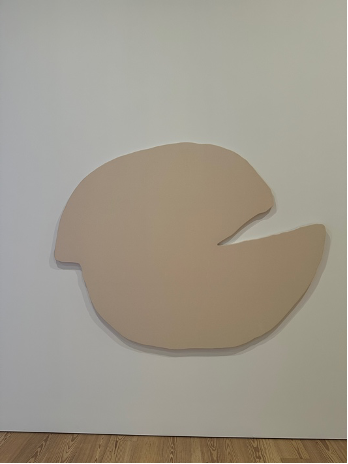
I believe this artwork, which expresses "all day" as the rising and setting of the sun and "all night" as the sun setting and rising again through sign language, most simply conveys the exhibition’s overarching concept. While this sculpture merely uses sign language to deliver meaning and the piece lacks a more detailed narrative. This suggests that she intended to express a sense of openness through this work.
In her exhibition catalog, she mentioned that because her first language is American Sign Language (ASL), she was always slower than others in the process of communication or forming relationships with people who could hear. Although she was born and raised in the United States and used ASL as her first language, she had to learn to communicate with American speakers later on, making it necessary for her to adapt despite being American herself. Later, as a Korean American, she wanted to connect with Korea and the Korean community, but since English was already a new language for her, she inevitably lagged behind other Korean Americans in learning about Korea. Some people think the fact that she cannot listen could be an obstacle for her to live like others. But she overcome her disability and expressed her life experiences with her artworks, in her own way.
Through this exhibition, I felt that she is not only navigating the time it takes to belong to a community or form new relationships but also acting as a leader and agent who forges and shapes new connections through her works, which unfold in various ways as mediators.
She expresses her unique life and experiences in a way that allows people to easily approach and understand them by using various media. At the same time, she presents a sharp critique of the perspectives and experiences she has encountered, which I found particularly striking. The experiences she has lived through are not something that can simply be dismissed as "interesting experiences." Nevertheless, rather than stopping at viewing difficult and challenging situations as merely tough, I believe this exhibition focuses how the artist communicate with people and the world by her own voices and expands the concepts and scope of sound and experience.
In some exhibitions, when there are too many artworks or an excessive use of color, the space can feel overwhelming, making it difficult to focus or know where to direct my gaze. As we can see in the pictures, most of her works are based on black and white, and sometimes use vibrant colors. Despite being the largest exhibition of Christine's works, this exhibition remained easy to navigate. Thanks to her carefully selected color palette and the stable, well-arranged space, the viewing experience was not overwhelming, even with a large number of visitors and no fixed order for beginning or ending the exhibition. Besides, since the artist herself is deaf, there were many booklets about her artwork described in ASL, which is very considerate. However, I wish there are more spaces that can enjoy her exhibition catalogue in the museum spaces.
Due to the spatial arrangement of the Whitney, even a solo exhibition is often spread across multiple floors, which may lead to varying opinions among visitors. Personally, I do not particularly prefer exhibitions on a single theme being divided across different floors within the same building. However, I enjoyed being able to appreciate the artworks alongside the large windows, good weather, and natural light, making it a pleasant experience.
People have five senses that are sight, smell, taste, touch and sound. After the exhibition, I realized that communicating is not about sound nor talking to each other. It is about how we express our feelings or ideas, whatever the tools are. And Kim utilizes sound, language, and the complexities of communication in her wide-ranging approach to art-making. She is the one who is doing her job very well.
Comments